Asianfail by Ty Eleanor;
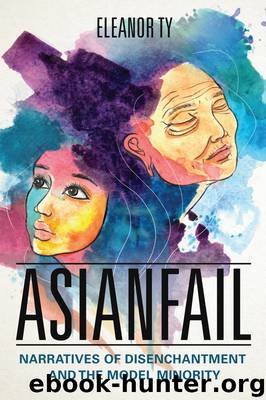
Author:Ty, Eleanor;
Language: eng
Format: epub
Publisher: University of Illinois Press
Published: 2017-04-16T04:00:00+00:00
1. In “Three Essays on the Theory of Sexuality,” Freud describes how a healthy child transfers his sexual impulses from his parents to other figures (299 & ff).
CHAPTER 4
Representations of Aging in Asian Canadian Performance
Life is not a series of gig lamps symmetrically arranged; life is a luminous halo, a semi-transparent envelope surrounding us from the beginning of consciousness to the end.
—Virginia Woolf, “Modern Fiction”
Our contemporary society views aging as an inevitable process characterized by a series of losses, by the slow decline of powers and prowess, and by the diminution of physical, mental skills, and cognitive function. In a world where beauty and ability are associated with the young, the aged are constantly urged to battle their bodily changes through makeup, medicine, surgery, and other kinds of treatments. Anthropologist Peter Stephenson writes, “As an impediment, age has become commoditized, brokered, commercialized, and the principal object of a vast system of health-care practices that make the elderly the primary target of the political economy of aging” (4, paraphrasing Stephen Katz). He calls our society today a “culture of novelty” with its emphasis on “‘youth culture’ in marketing and the major industries of the self which focus on the body in consumer culture—cosmetics, clothing, and many forms of health care associated with the ‘anti-aging’ movement” (4). These industries, he says, are “an unfailing index of the importance of individuated forms of newness or novelty” (4). To be old, in short, is to be a failure, someone to be pitied, tolerated, humored, or ignored.
In contrast to this view of aging is the veneration of the old among some non-Western and nonmodern cultures, such as Aboriginal and Asian. Aging and elders in these cultures are associated with wisdom, with insights and experiences accumulated over time. In both Chinese and Japanese societies, Confucian principles of filial piety, the practice of respecting and caring for one’s parents in their old age, have been used recurrently in history as a basis of social order, spiritual anchoring, moral conduct, and social control (Hashimoto and Ikels, 437). Akiko Hashimoto and Charlotte Ikels note, “Historically, respect for elders has been an integral part of the practice of ancestor reverence in the traditional family systems in East Asia. In the moral order of the ‘traditional’ family, the elderly held higher spiritual status with advancing age” (437). Stephenson contends that in Western culture, “what is conventionally termed ‘the aging process’ is especially constrained in both biological and cultural arenas by a notion of linear time still firmly rooted in a now discredited kind of Newtonian physics, which lends it an aura of constancy and universality” (10). According to Stephenson,
Time is conventionally understood as quantifiable and delimited—a “thing” that can be “spent,” “saved,” and “lost”; indeed, it is frequently “invested.” “Time is money” is a common phrase, so time can be said to have assumed the status of virtual currency in a temporal commodities market that now operates globally. Time and money are both employed as finite measures, so time is comprehended as a material commodity.
Download
This site does not store any files on its server. We only index and link to content provided by other sites. Please contact the content providers to delete copyright contents if any and email us, we'll remove relevant links or contents immediately.
The Great Music City by Andrea Baker(33267)
Aircraft Design of WWII: A Sketchbook by Lockheed Aircraft Corporation(32374)
Call Me by Your Name by André Aciman(20689)
The Secret History by Donna Tartt(19432)
The Art of Boudoir Photography: How to Create Stunning Photographs of Women by Christa Meola(18742)
Shoot Sexy by Ryan Armbrust(17834)
Plagued by Fire by Paul Hendrickson(17520)
Portrait Mastery in Black & White: Learn the Signature Style of a Legendary Photographer by Tim Kelly(17093)
Adobe Camera Raw For Digital Photographers Only by Rob Sheppard(17072)
Photographically Speaking: A Deeper Look at Creating Stronger Images (Eva Spring's Library) by David duChemin(16786)
Ready Player One by Cline Ernest(15104)
Pimp by Iceberg Slim(14771)
Bombshells: Glamour Girls of a Lifetime by Sullivan Steve(14205)
The Goal (Off-Campus #4) by Elle Kennedy(13935)
Art Nude Photography Explained: How to Photograph and Understand Great Art Nude Images by Simon Walden(13137)
Kathy Andrews Collection by Kathy Andrews(12059)
The Priory of the Orange Tree by Samantha Shannon(9338)
The remains of the day by Kazuo Ishiguro(9186)
Thirteen Reasons Why by Jay Asher(9089)
